Carbon fiber composite cylinders have become an important option for storing high-pressure breathing air in applications such as SCBA, respirators, firefighting, rescue, mining and other professional fields. Among the different composite cylinder designs, Type 4 cylinders use a fully non-metallic liner, normally made from PET, combined with a carbon fiber composite structural layer.
A Type-4 cylinder is different from a traditional steel or aluminum cylinder not simply because it uses carbon fiber. Its performance comes from the way several materials work together. The liner contains the gas, the carbon fiber composite carries the main structural load, and the external protective layers help protect the cylinder from everyday physical and environmental damage.
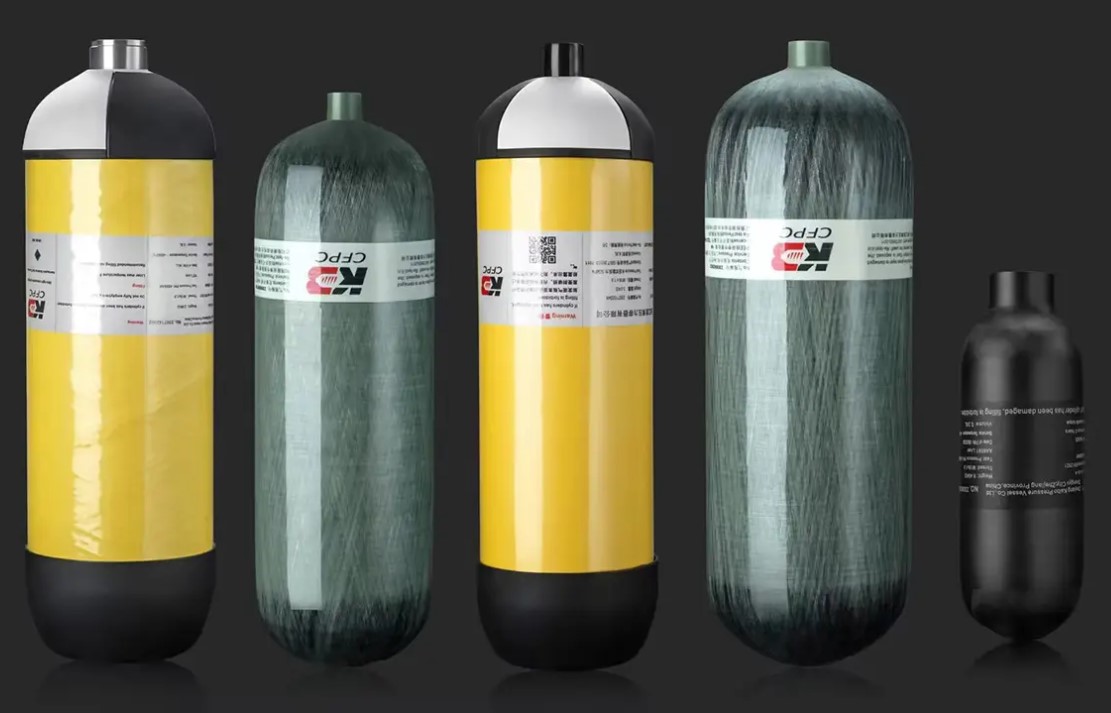
The 6.8-liter Type-4 carbon fiber cylinder described in the manufacturer’s materials is designed for breathable air applications. It has a 300-bar working pressure, 450-bar test pressure and a stated weight of approximately 3.0 kg. It uses a PET liner, carbon fiber/epoxy composite structure, protective outer layers and rubber protection at the top and bottom.
Understanding how these parts work together, and how the cylinder should be filled, transported, stored and inspected, is important for getting the benefits of Type-4 construction without creating unnecessary risks.

1. What Is a Type-4 Carbon Fiber Cylinder?
A Type-4 composite cylinder consists of three main functional areas.
PET liner
The innermost component is the PET liner. Its primary purpose is to contain the gas.
Unlike a traditional metal cylinder, the PET liner is described in the manual as a non-load-bearing structural layer. In other words, it is not intended to carry the main pressure load of the cylinder.
This is an important point when understanding Type-4 construction. The PET liner provides the gas-tight internal surface, while the carbon fiber composite surrounding it provides the mechanical strength needed to contain the high internal pressure.
Carbon fiber composite layer
The middle layer is made from high-performance carbon fiber with an epoxy resin matrix.
This is the primary structural and stress-bearing layer of the cylinder. When the cylinder is filled to high pressure, the internal pressure produces stress in the cylinder wall. The carbon fiber composite layer is designed to carry this load.
The carbon fiber is therefore not simply an outer covering or decoration. It is the main pressure-bearing part of the Type-4 cylinder.
External protective layers
The outermost part of the cylinder includes protective finishing, sleeves, caps and, depending on the product configuration, additional protective materials.
The advertising specification describes two possible outer protection options:
- A high-polymer protective coat.
- A glass-fiber wrapping combined with UV painting.
Rubber caps and boots are also used to provide additional protection, particularly around areas that may experience contact or impact.
The protective layer does not replace the carbon fiber structural layer. Its main role is to reduce the possibility of damage to the underlying cylinder during normal handling, transportation and use.
2. Why Use PET Instead of a Metal Liner?
The use of a PET liner is one of the main differences between Type 4 and Type 3 composite cylinders.
A Type-3 cylinder generally combines a metal liner with a carbon fiber structural wrap. A Type-4 design removes the metal liner and replaces it with a non-metallic PET liner.
This can reduce the overall cylinder weight.
For a 6.8-liter cylinder with a 300-bar working pressure, the manufacturer’s label gives a weight of approximately 3.0 kg. The lower weight can be useful in SCBA and respiratory equipment, where the cylinder is carried by the user.
There is also a practical difference in corrosion behavior. Because the gas-containing liner is made from PET rather than aluminum or steel, the internal gas-contact surface does not have the same metal corrosion mechanism as a conventional metal liner.
However, this does not mean that the cylinder can be exposed to chemicals, contamination or high temperatures without concern. PET has its own material limitations, and the manual specifically warns against incompatible chemicals, contamination, excessive temperature and vacuum conditions.
3. The Main Advantage: Lower Weight
Weight is one of the clearest practical advantages of a Type-4 carbon fiber cylinder.
In SCBA and respirator applications, the cylinder is carried together with the breathing apparatus and other equipment. Reducing cylinder weight can therefore reduce the total load carried by the user.
For example, the specified 6.8-liter cylinder weighs approximately 3.0 kg. This weight should be considered together with the valve, regulator, harness and other equipment when calculating the complete system weight.
The benefit is not simply that the cylinder is easier to pick up. Lower cylinder weight can also make the complete breathing system easier to carry during walking, climbing, rescue work or other activities where equipment is worn for an extended period.
For this reason, Type-4 construction is particularly attractive where mobility is important.
4. High Pressure and Gas Capacity

The cylinder described in the manual has:
- Water volume: 6.8 L
- Working pressure: 300 bar
- Test pressure: 450 bar
- Weight: approximately 3.0 kg
- Service temperature: -40°C to 60°C on the product label
- Thread: M18 × 1.5
- Recommended valve installation torque: 85 N·m
The 300-bar working pressure allows a relatively large quantity of compressed air to be stored in a compact cylinder.
For SCBA and other breathing-air applications, this combination of pressure, volume and low cylinder weight is one of the main reasons composite cylinders are attractive.
However, higher pressure also means that filling must be properly controlled. The working pressure shown on the cylinder label is a maximum operating pressure, not a target that should be exceeded under any circumstances.
The manual clearly states that the cylinder must not be charged above its working pressure.
5. Breathable Air Only
The product label specifies:
“Breathable air only EN 12021.”
This is particularly important for a cylinder intended for SCBA and respirator applications.
A high-pressure cylinder should not be treated as a general-purpose gas container simply because it is physically capable of containing high pressure.
The manual specifically recommends filling only with breathable air complying with EN 12021 and states that filling should be carried out by authorized persons or entities.
Gas quality therefore matters as much as pressure.
The filling system must provide suitable, clean and dry breathing air. Contamination of the PET liner or internal cylinder surface should be avoided.
6. Filling Rate and Temperature Control
Filling a high-pressure cylinder generates heat. This is one reason the manual places particular attention on filling speed and cylinder temperature.
The recommended filling rate is below 30 bar/min.
Slow filling helps control temperature and is recommended by the manufacturer to protect the liner.
The manual also provides guidance for faster filling. If the filling rate exceeds 30 bar/min, special attention must be paid to cylinder temperature, which must not exceed 60°C during filling.
The cylinder must also not be immersed in water during charging.
There are several temperature values in the manufacturer’s documentation, and they apply to different conditions:
- The product label states a service temperature of -40°C to 60°C.
- During filling, the cylinder temperature must not exceed 60°C.
- The general operating instructions prohibit the cylinder temperature from exceeding 65°C.
- The filling section separately states that the PET liner’s maximum temperature is 80°C.
These values should not be interpreted as permission to operate the complete cylinder at 80°C. The 80°C figure appears in the filling specification for the liner, while the operating and filling instructions give lower limits for the cylinder. In practical operation, the more restrictive operating limits should be followed.
7. Why Vacuum Must Be Avoided
One of the most important differences in handling a Type-4 cylinder is the warning against vacuum.
The manual states that Type-4 cylinders must not be subjected to a vacuum.
This relates directly to the PET liner. Because the liner is not the structural pressure-bearing layer, the pressure relationship between the inside of the liner and the surrounding composite structure is important.
The manual explains that vacuum conditions can cause the liner to deform. It specifically describes inward bulging as a possible result of vacuum.
Therefore, users should not deliberately evacuate the cylinder, connect it to a vacuum system, or use a procedure that can create vacuum inside the cylinder.
This point is especially important during testing and water draining.
8. Hydrostatic Testing and Water Removal
During hydrostatic testing, the manual provides a specific procedure designed to prevent vacuum formation.
The cylinder should not simply be drained vertically.
Instead:
1-Place the cylinder horizontally to drain the water.

2-After this, invert the cylinder approximately 45 degrees.

3-Finally, position it vertically to complete the drainage.

The purpose of this sequence is to prevent a vacuum from developing inside the Type-4 cylinder.
The manual also states that Type-4 cylinders are not subject to autofrettage.
For hydraulic testing, the manual refers to Test 4 of EN 12245 and recommends initially pressurizing the cylinder to working pressure and holding it for 60 seconds to expel air before the hydrostatic test.
This is a procedure for qualified testing personnel rather than ordinary users.
9. Inspection and Damage: What Users Need to Look For
A carbon fiber cylinder should not be judged only by whether it is leaking.
A cylinder can have structural damage without immediately showing an obvious gas leak.
The manufacturer’s damage classification separates damage into several areas.
Protective finishing damage
Minor damage to the outer sleeve or protective finishing does not necessarily affect cylinder performance.
If only the protective finishing is damaged and the carbon fiber layer underneath is confirmed to be intact, the manual classifies this as a lower-level finishing issue.
However, if the protective layer has been completely destroyed, the area underneath needs careful inspection.
Carbon fiber composite damage
This is much more serious.
The manual states that if damage to the composite layer is found, use of the cylinder should immediately be stopped and the manufacturer should be contacted for assessment.
Examples of serious composite damage include:
- Severe scratches, cuts or cracks
- Impact damage
- High-temperature damage
- Delamination
- Chemical attack
These are classified as Level 3 damage in the manual and require rejection of the cylinder.
This is why a carbon fiber cylinder should never be thrown, dropped, rolled or dragged across the ground.
Nozzle and thread damage
The cylinder neck and valve connection require particular attention.
Minor surface scratches may not affect structural performance but can reduce corrosion protection.
More serious damage involving the sealing groove or thread area requires professional assessment and potentially nozzle replacement.
Structural impact damage or severe chemical corrosion is a rejection condition.
10. PET Liner Damage
The PET liner has its own damage considerations.
The manual identifies several possible problems, including blistering, bulging, foreign matter, contamination and damage associated with excessive temperature or vacuum.
Because the liner’s primary function is to contain the gas, the manual distinguishes liner damage from damage to the carbon fiber structural layer.
For example, the manual states that certain blistering conditions can be corrected by pressurizing the cylinder above 50 bar, while liner deformation caused by vacuum may recover after pressurization above 10 bar.
However, this should not be interpreted as permission for users to repair damaged cylinders themselves.
Where the manual calls for manufacturer assessment, that procedure should be followed. Irreversible liner damage caused by excessive temperature, corrosive substances or contamination is identified as a rejection condition.
11. Cleaning and Maintenance
External cleaning is relatively straightforward.
Mild cleaning agents such as soap or dish detergent can be used, followed by thorough rinsing.
Hot water can be used for external cleaning, but its temperature should not exceed 45°C.
Cleaning agents that may corrode or otherwise damage the cylinder surface should not be used.
Internal cleaning requires greater care because the PET liner is directly involved.
The manual permits mild soap and water for internal cleaning, followed by thorough rinsing. Cleaning chemicals that are incompatible with PET must not be used.
The internal surface can be dried using clean, dry, oil-free air. If warm air is used, its temperature should not exceed 60°C.
Solid materials should not be inserted into the cylinder to clean the internal surface.
This is a simple but important point: internal cleaning should not introduce scratches, contamination or incompatible chemicals.
12. Valve Installation and Removal
The valve connection is another area where incorrect handling can damage the cylinder.
Valve installation and removal should be performed by authorized organizations or individuals.
Before installation, the cylinder thread and gasket groove should be checked for damage and foreign matter. The valve itself should also be inspected.
The valve should first be hand-tightened. The installation should feel smooth. If abnormal resistance is felt, the operation should stop rather than forcing the valve.
The manufacturer’s recommended valve installation torque is 85 N·m.
When securing the cylinder during valve installation, the manual specifies the use of a counter wrench and a torque wrench. If jaws are used, flexible material should be placed between the jaws and the cylinder surface. Excessive clamping force or hard jaw material can damage the cylinder.
For valve removal, the cylinder must first be emptied, and the discharge rate should not exceed 260 L/min.
If the valve is unusually difficult to remove, the operation should stop and the manufacturer should be contacted.

13. Storage
Proper storage helps protect the cylinder from unnecessary damage.
The manufacturer’s recommended conditions include:
- Stable positioning to prevent rolling or impact
- A clean and dry storage environment
- Separation from chemical substances
- Internal pressure maintained above 2 bar
- Ambient temperature between -30°C and 60°C
The instruction to maintain pressure above 2 bar is closely related to the Type-4 design and the need to avoid vacuum.
A cylinder should therefore not simply be stored completely empty for long periods.
It should also be protected against physical damage rather than left where it can fall, roll or be struck by other equipment.
14. Transportation
Transportation must comply with applicable national regulations.
The cylinder should be packed with sufficient protection to prevent impact, contamination and other physical damage.
Whenever possible, the manufacturer recommends transporting the cylinder with internal pressure maintained at approximately 2 bar.
If regulations or transport conditions do not permit transportation under pressure, the manual gives a specific procedure after receipt:
- Fill the cylinder with approved gas to 50 bar.
- Empty it at a rate below 260 L/min.
- Refill it to 2 bar for storage.
Transportation therefore needs to consider both physical protection and the internal condition of the PET liner.
15. “Non-Limited Life” Does Not Mean No Inspection Is Required
The advertising statement describes the cylinder as having a “limitless lifespan,” while the product information uses the more precise term “non-limited life” or NLL (Non-Limited-Lifespan).
This wording should be understood carefully.
Non-limited life does not mean that the cylinder can be used forever regardless of its condition.
The cylinder still has to pass the required inspections and periodic retesting. The manual gives a maximum retest period of five years.
If structural damage, chemical attack, severe heat damage, delamination or other rejection conditions are found, the cylinder may have to be removed from service regardless of its stated design life.
In practical terms, “non-limited life” means that the design does not specify a fixed calendar-based end-of-life date under the manufacturer’s stated conditions. Continued use remains dependent on inspection, testing, proper maintenance and the condition of the cylinder.
16. Why Type-4 Is Suitable for SCBA and Respirators
The characteristics of Type-4 construction fit several requirements of breathing-air equipment.
First, the low weight can reduce the load carried by the user.
Second, the 300-bar working pressure provides a large compressed-air capacity in a relatively compact package.
Third, the PET liner avoids the metal liner used in Type-3 construction.
Fourth, the carbon fiber composite provides the primary structural strength.
Finally, the outer protective system adds another layer of protection against normal handling conditions.
The manufacturer’s materials state that the cylinder design, manufacture and testing comply with EN 12245 and that the cylinders are CE approved in accordance with the PED directive.
For buyers, however, certification should always be checked against the exact cylinder model, marking, certificate and intended application rather than assuming that one certificate covers every configuration.
17. Practical Rules for Users
The most important operating rules can be summarized simply:
Do:
- Use only approved breathable air.
- Have filling performed by authorized personnel or entities.
- Keep filling temperature under the specified limit.
- Prefer filling below 30 bar/min.
- Keep the cylinder clean and dry.
- Maintain internal pressure above 2 bar during storage where applicable.
- Protect the cylinder during transportation.
- Inspect the carbon fiber surface regularly.
- Follow the five-year maximum retest interval stated in the manual.
- Contact the manufacturer when structural damage or abnormal conditions are found.
Do not:
- Exceed 300 bar working pressure.
- Create a vacuum inside the cylinder.
- Expose the cylinder to excessive heat.
- Throw, hit, roll or drag the cylinder.
- Expose it to corrosive chemicals.
- Fill it with unapproved gases.
- Lift it by the valve.
- Use valves with sintered filters where prohibited by the manual.
- Use incompatible chemicals inside the PET liner.
- Discharge it faster than 260 L/min.
- Modify the cylinder without manufacturer authorization.
- Continue using a cylinder with suspected structural composite damage.
The basic principle is straightforward: the carbon fiber layer carries the pressure load, the PET liner contains the gas, and the protective layers protect the cylinder from external damage. Proper handling is necessary to keep all three parts working as designed.
FAQ
1. What is the main difference between a Type-4 and a Type-3 carbon fiber cylinder?
The main difference is the liner. Type-4 uses a non-metallic PET liner, while Type-3 uses a metal liner, typically aluminum, combined with a carbon fiber structural wrap. The Type-4 design can therefore achieve lower weight.
2. Is the PET liner the part that carries the 300-bar pressure?
No. According to the manufacturer’s design description, the PET liner is non-load-bearing and its main function is to contain the gas. The carbon fiber/epoxy composite layer is the primary structural and stress-bearing layer.
3. Can the cylinder be used for CO₂ or other gases?
The specified product is labeled “breathable air only EN 12021.” Therefore, this particular configuration should not be treated as a general-purpose gas cylinder. Only gases approved for the specific cylinder should be used.
4. Can I completely empty the cylinder?
The manual states that the cylinder should not be fully emptied and recommends maintaining pressure above 2 bar. This is also important for avoiding conditions that could lead to vacuum formation.
5. Why is vacuum prohibited?
A vacuum can cause deformation of the PET liner. The manual specifically identifies inward liner bulging as a possible result of vacuum conditions.
6. What is the recommended filling speed?
The recommended filling rate is below 30 bar/min. Faster filling is possible according to the manual, but temperature must then be carefully controlled and must not exceed the specified filling limit.
7. Can I fill the cylinder in water to control temperature?
No. The filling instructions specifically state that the cylinder should not be immersed in water during charging.
8. What should I do if the carbon fiber has a scratch?
Do not automatically assume that every scratch makes the cylinder unusable, but do not ignore it either. The manual distinguishes between different levels of damage. If the composite layer may have been damaged, stop using the cylinder and contact the manufacturer for assessment.
9. What kinds of damage require rejection?
The manual identifies severe cuts, cracks or scratches, impact damage, high-temperature damage, delamination and chemical attack of the composite layer as Level 3 structural damage requiring rejection.
10. Does “non-limited life” mean the cylinder never needs retesting?
No. The cylinder still requires periodic inspection and retesting. The manufacturer’s label specifies a maximum retest period of five years.
11. How should the cylinder be stored?
It should be stored in a clean, dry environment, protected from chemicals, physical impact and rolling, with internal pressure above 2 bar. The specified ambient storage temperature is -30°C to 60°C.
12. Can ordinary detergent be used for cleaning?
Mild soap or dish detergent can be used for external cleaning. Internal cleaning also permits mild soap and water, but any chemical used must be compatible with PET. Hot water for external cleaning should not exceed 45°C.
13. Can the valve be replaced by the end user?
Valve installation and removal should be performed by authorized organizations or individuals. The manual specifies a recommended installation torque of 85 N·m and gives specific procedures for securing the cylinder during valve work.
14. Why is carbon fiber a good choice for SCBA and respirator cylinders?
The main reasons are the combination of high-pressure capability and low weight. A Type-4 cylinder can provide a 300-bar working pressure while using a lightweight PET liner and carbon fiber structural layer. This can reduce the weight carried by the user while maintaining high-pressure gas storage capacity.
15. What is the most important thing to remember when using a Type-4 cylinder?
The most important point is to treat it as a certified high-pressure pressure vessel, not simply as a lightweight container. Use the correct gas, stay within the specified pressure and temperature limits, avoid vacuum and physical or chemical damage, follow the filling and storage instructions, and have any suspected structural damage assessed by qualified personnel or the manufacturer.
Post time: Sep-11-2026